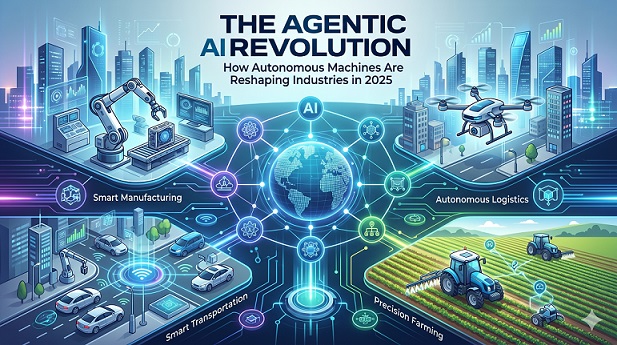
The Agentic AI Revolution: How Autonomous Machines Are Reshaping Industries in 2025

Introduction: A New Intelligence Is at Work
Something fundamental has changed about artificial intelligence — and most people have not noticed yet.
For years, AI existed as a reactive tool. You typed a question, it returned an answer. You uploaded an image, it generated a caption. The relationship was transactional, bounded, and fundamentally passive. Humans were always the ones setting goals, executing decisions, and reviewing results.
That model is quietly being dismantled.
In 2025, we are witnessing the early but unmistakable rise of agentic AI — systems that do not merely respond to commands but pursue goals, decompose complex tasks, coordinate with other AI systems, and iterate toward outcomes without constant human handholding. These are not chatbots. They are autonomous agents operating in digital — and increasingly physical — environments.
The shift is being felt across virtually every sector. In healthcare, AI agents are reviewing patient data and flagging anomalies before doctors even open a chart. In software development, autonomous coding agents are shipping tested features overnight. In logistics, machine learning models reroute supply chains in real time based on weather, political instability, and market signals simultaneously.
This article is a comprehensive guide to understanding agentic AI and the broader machine learning revolution reshaping industries in 2025. We will cover what these systems actually are, how they work, where they are delivering genuine value, what risks they introduce, and what the next five years may look like for businesses and individuals navigating this transformation.
Part 1: What Is Agentic AI — and Why Does It Matter?
From Assistant to Agent
The easiest way to understand the leap from traditional AI to agentic AI is through a simple analogy. Traditional AI is like a very knowledgeable receptionist: you ask them something specific, they look it up, and hand you the answer. An agentic AI is more like a highly capable project manager who you give a goal to — and they figure out all the steps, tools, and decisions needed to accomplish it without asking you every five minutes.
Technically, an AI agent is a system that can perceive its environment, reason about it, take actions, observe the consequences of those actions, and adjust its behavior to achieve a specified goal. The key components distinguishing agents from traditional AI models are:
- Goal-directedness: agents work toward outcomes, not just outputs
- Tool use: they can call APIs, search the web, write and execute code, or control software interfaces
- Multi-step planning: they break complex objectives into sub-tasks and sequence them logically
- Memory and context retention: they can recall prior steps within a task and sometimes across sessions
- Self-correction: when a step fails, they retry, adjust, or take a different path
Modern agentic systems are typically built on top of large language models (LLMs) — the same class of technology behind ChatGPT, Claude, and Gemini — but equipped with additional scaffolding that allows them to act, not just talk.
The Enabling Technologies
Agentic AI did not emerge from a single breakthrough. It is the product of several converging technological advances:
Larger, more capable foundation models: The base intelligence of today’s LLMs is dramatically more capable than models from even two years ago. They reason better, hallucinate less, and maintain coherence across longer contexts — critical for multi-step agent tasks.
Multimodal reasoning: Modern AI agents are no longer text-only. They can process images, audio, video, PDFs, spreadsheets, and code in tandem, enabling them to operate in real-world environments where information comes in many forms.
Function calling and tool integration: APIs that allow AI models to invoke external tools — a web browser, a calculator, a database, a calendar — have matured significantly, making it practical to deploy agents that interface with real systems.
Improved orchestration frameworks: Developer tools and frameworks for building multi-agent pipelines have lowered the technical barrier to deploying agents at scale.
Edge deployment: Advances in model compression and hardware efficiency mean that capable AI models can increasingly run on local devices — enabling agents to operate without constant cloud connectivity.
Part 2: Industry Transformation — Where Agentic AI Is Delivering Results
Healthcare: From Data Overload to Clinical Precision
Healthcare has long been described as an industry drowning in data. Electronic health records, genomic databases, medical imaging, research literature — the volume of clinically relevant information is staggering, and no human physician can realistically synthesize it all in real time.
Machine learning is beginning to address this. Radiology has emerged as one of the most advanced frontiers: AI models trained on millions of scans now match or exceed specialist-level performance in detecting certain cancers, diabetic retinopathy, and cardiovascular anomalies in imaging data. Crucially, these systems flag findings that might have been missed and prioritize urgent cases in the radiologist’s worklist.
But the more significant shift in 2025 is happening at the system level. Hospitals are deploying agentic AI platforms that can:
- Monitor patient vitals continuously and alert staff to early signs of sepsis or deterioration
- Cross-reference a patient’s medication list against current literature to flag interaction risks
- Draft clinical notes, referral letters, and discharge summaries from voice recordings of physician consultations
- Coordinate scheduling, insurance pre-authorization, and follow-up appointment logistics autonomously
One of the most promising — and ethically complex — applications is AI-assisted diagnostics for underserved populations. In regions with severe shortages of specialist physicians, AI systems are enabling general practitioners and community health workers to access specialist-level diagnostic support at scale.
The risks are significant. AI diagnostic errors, liability when AI recommendations contribute to adverse outcomes, and the potential for algorithmic bias against underrepresented populations are all active concerns that health regulators worldwide are grappling with. The technology’s capabilities are advancing faster than the governance frameworks designed to oversee it.
Finance: Intelligent Automation Beyond Fraud Detection
Financial services was one of the first industries to adopt machine learning at scale, primarily for fraud detection and credit scoring. In 2025, the scope of AI in finance has expanded considerably.
Algorithmic trading is not new, but the sophistication of models has increased substantially. Hedge funds and proprietary trading desks are using reinforcement learning systems — AI models that learn through trial and error in simulated market environments — to develop strategies that adapt to novel market conditions rather than relying solely on historical patterns.
In retail banking and wealth management, agentic AI is handling an expanding share of customer-facing interaction. AI systems now handle complex account inquiries, process loan applications by pulling and analyzing supporting documents, and generate personalized financial planning summaries. The goal is not to replace financial advisors but to augment them — allowing human advisors to focus on relationship-building and complex judgment calls while AI handles information retrieval and routine analysis.
Risk management and regulatory compliance are perhaps the most impactful near-term applications. Financial institutions are under enormous pressure to monitor transactions for money laundering, sanction violations, and market manipulation in real time across millions of daily transactions. Machine learning models handle this at a scale and speed that human compliance teams cannot match — though they also introduce new risks of false positives, bias, and regulatory blind spots.
Manufacturing and Supply Chain: The Self-Optimizing Factory
Manufacturing was already being transformed by automation before AI entered the picture. What machine learning adds is adaptability — the ability to optimize not just for a fixed set of conditions but for an ever-changing environment.
Predictive maintenance is one of the most widely deployed applications. By analyzing sensor data from industrial equipment — vibration, temperature, acoustic signatures — ML models can predict component failures days or weeks before they occur, enabling scheduled maintenance that prevents costly unplanned downtime. The economic returns are measurable and have driven rapid adoption.
Quality control has similarly been transformed. Computer vision systems trained to detect defects in manufactured components now outperform human inspectors on many production lines — particularly for micro-defects that are difficult to spot with the naked eye under production-line time constraints.
Supply chain optimization is where agentic AI is having its most sophisticated impact. Systems that can simultaneously model demand forecasting, inventory levels, supplier lead times, transportation routes, and external risk factors — and then proactively reorder, reroute, or substitute suppliers in response to disruptions — represent a qualitatively new capability. During recent global supply chain disruptions, companies with advanced ML-driven supply chain management consistently recovered faster and maintained higher service levels than those relying on traditional planning tools.
Education: Personalized Learning at Scale
Education is a sector where AI’s potential is large, but implementation has been slower and more contested than in other industries.
Intelligent tutoring systems — AI that adapts the difficulty, format, and pacing of educational content to individual student performance — have been studied for decades. What has changed is the quality of the underlying models. Today’s AI tutors can engage in open-ended conversation about concepts, answer follow-up questions, identify misconceptions from the specific errors a student makes, and adjust their explanations dynamically.
In higher education and corporate training, AI-powered platforms are generating personalized learning pathways for employees acquiring new skills — a critical need in an era of rapid technological change. The ability to rapidly reskill workforces is widely seen as one of the defining competitive advantages of the coming decade, and AI-assisted learning is becoming central to how organizations approach it.
Part 3: The Risks and Challenges That Cannot Be Ignored
Hallucination and Reliability
Despite dramatic improvements in recent model generations, large language models still hallucinate — generating plausible-sounding but factually incorrect information with unwarranted confidence. In low-stakes applications, this is a nuisance. In healthcare, legal, financial, or safety-critical contexts, it is a serious risk.
Agentic systems compound this concern. When a single AI agent error becomes an incorrect step in a multi-step workflow — and subsequent steps are built on that incorrect output — the downstream consequences can be significant and difficult to trace. Ensuring that agentic systems have appropriate verification steps, human checkpoints, and fallback mechanisms is a major challenge for engineers and product teams deploying these systems.
The Bias Problem
Machine learning models learn from data, and data reflects the world — including its historical inequities. Biased training data produces biased models. This is not a theoretical concern: documented cases of algorithmic bias in hiring tools, facial recognition systems, and loan approval models have demonstrated real harm.
In 2025, as AI systems are deployed in higher-stakes decisions — medical triage, criminal justice risk scoring, welfare benefit eligibility — the stakes of unaddressed bias have increased. Rigorous bias auditing, diverse training data, and ongoing post-deployment monitoring are not optional components of responsible AI deployment; they are essential safeguards.
Economic Disruption and the Labor Question
The displacement of human workers by AI-powered automation is one of the most actively debated dimensions of the current technological moment. The honest answer is that the scale and distribution of labor market effects are genuinely uncertain.
Optimists point to historical precedent: previous waves of automation created new categories of work even as they eliminated others. Pessimists note that the breadth of AI’s current capabilities — affecting cognitive as well as physical labor — is qualitatively different from prior automation waves, and that the transition period may be more disruptive than historical comparisons suggest.
What seems clear is that certain categories of repetitive, structured cognitive work — data entry, basic document processing, routine customer service, certain aspects of financial analysis — are being automated at scale. And that the workers most exposed to displacement are often those with fewer resources to navigate the transition.
Security Vulnerabilities
AI systems introduce new attack surfaces. Prompt injection — manipulating an AI agent through malicious content embedded in the environment it operates in — is an emerging threat vector. An agent browsing the web and encountering a page with embedded instructions designed to hijack its behavior is a real risk, particularly as agents are granted greater access to sensitive systems and data.
Adversarial examples — inputs designed to fool machine learning models — remain a challenge, particularly in computer vision applications. And as AI is used for security purposes (threat detection, fraud prevention), adversaries are also using AI to evade those systems in an escalating technical arms race.
Regulatory Uncertainty
Governments worldwide are grappling with how to regulate AI. The European Union’s AI Act — which categorizes AI applications by risk level and imposes corresponding compliance requirements — is the most comprehensive regulatory framework yet implemented. The United States has taken a more fragmented, sector-by-sector approach. China has issued specific regulations around generative AI. Most other jurisdictions are still developing their frameworks.
This regulatory uncertainty creates genuine challenges for businesses deploying AI globally. Systems that are permissible in one jurisdiction may require modification or be prohibited in another. The compliance landscape is evolving rapidly, and organizations that treat AI governance as a purely technical concern — rather than a legal, ethical, and reputational one — are exposed.
Part 4: The Horizon — What Comes Next
Multimodal and Embodied Intelligence
The next frontier for AI extends beyond language and images into the physical world. Robotics combined with advanced AI is producing systems that can navigate unstructured environments, manipulate objects, and learn from demonstration — skills that until recently were considered far beyond AI’s near-term reach.
Warehouse automation and logistics robots have already made this transition in controlled environments. The research frontier in 2025 involves extending this capability to less structured settings — homes, construction sites, agricultural fields — where the variability of the environment makes rigid automation impractical.
Smaller, More Efficient Models
The trend in foundation model development is not exclusively toward larger models. Significant research effort is being directed toward making capable models smaller, faster, and cheaper to run — enabling deployment on smartphones, edge devices, and in resource-constrained environments.
This democratization of AI capability has important implications: it brings AI-powered applications within reach of smaller businesses, developing economies, and use cases where cloud connectivity is unreliable or privacy concerns preclude sending data to external servers.
Human-AI Collaboration as the Default Paradigm
The most durable and productive near-term vision for AI is not one of replacement but of augmentation. The systems delivering the most consistent value today are those designed to enhance human decision-making rather than supplant it — providing richer information, flagging considerations that might be missed, handling routine components of complex workflows, and freeing human attention for the judgment calls where it is most valuable.
Building effective human-AI collaboration requires deliberate design: clear delineation of what the AI handles versus what requires human review, well-designed interfaces that communicate AI confidence and uncertainty, and organizational cultures that treat AI recommendations as inputs to human judgment rather than authoritative verdicts.
Conclusion: Navigating the Transformation
We are living through a genuine inflection point in the history of technology. Agentic AI and the broader machine learning revolution are not incremental improvements on prior tools — they represent a qualitative shift in what machines can do and where they can be deployed.
The benefits are real: dramatically accelerated scientific discovery, healthcare outcomes that were not previously achievable, more efficient systems that reduce waste, and new capabilities for people who previously lacked access to expert knowledge.
The risks are also real: reliability failures in high-stakes contexts, entrenched and scaled-up bias, labor market disruption, security vulnerabilities, and governance frameworks that are struggling to keep pace with technological change.
What this moment calls for is neither uncritical enthusiasm nor reflexive resistance, but thoughtful engagement: understanding how these systems actually work, being honest about their limitations, advocating for governance frameworks that protect against genuine harms, and deliberately designing human-AI collaboration in ways that enhance rather than diminish human agency and wellbeing.
The machines are not going away. The question is what kind of relationship we build with them — and who gets to shape that answer.
Related posts:
 Installing Monit On Fedora 38
 How To Install PHP 8.3.6 On CentOS Stream 9
 How To Install Zint, A Barcode Generator On Ubuntu 24.04
 Apple iPhone 17 Pro Max: Everything You Need to Know
 Apache Iceberg: The Next-Generation Table Format for Big Data Analytics
 Install Portainer on Ubuntu 22.04 Easily — Complete Docker Setup Tutorial
 How to Install Oppia on CentOS Stream 10 – A step-by-step guide for ed-tech developers
 How to Install MQTT on Docker (Step-by-Step Tutorial for Beginners)
