CockroachDB: A Cloud-Native Distributed SQL Database Built for Global Scale

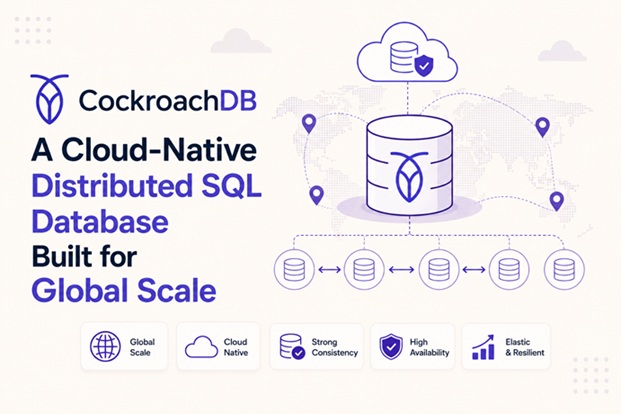
Modern applications demand more than just storing data. They require high availability, global scalability, and strong consistency, all while minimizing operational complexity. Traditional relational databases often struggle to meet these requirements when deployed at scale across regions.
This is where CockroachDB comes in.
CockroachDB is a distributed SQL database designed from the ground up for cloud environments. Inspired by Google Spanner, it combines the familiarity of SQL with the resilience and scalability of distributed systems. Its core promise is simple yet powerful: survive failures, scale effortlessly, and keep data consistent—automatically.
What Is CockroachDB?
CockroachDB is an open-source, cloud-native, NewSQL database that provides:
- SQL support with PostgreSQL compatibility
- Automatic replication and self-healing
- Horizontal scaling across nodes and regions
- Strong consistency using distributed transactions
Unlike traditional databases that rely on a single primary node, CockroachDB distributes data evenly across multiple nodes, eliminating single points of failure.
Key Architecture Concepts
Understanding CockroachDB’s architecture helps explain why it performs so well in distributed environments.
1. Distributed Key-Value Store
At its core, CockroachDB stores data in a distributed key-value layer. SQL tables, indexes, and rows are mapped onto this layer, allowing data to be automatically sharded and replicated.
2. Ranges and Replication
Data is divided into small chunks called ranges. Each range is replicated (typically three times) across different nodes using a consensus protocol.
This means:
- Node failures do not cause downtime
- Reads and writes can continue seamlessly
- Data is always protected against loss
3. Raft Consensus Algorithm
CockroachDB uses the Raft consensus protocol to ensure strong consistency. Every write must be agreed upon by a majority of replicas, guaranteeing correctness even during network partitions.
PostgreSQL Compatibility
One of CockroachDB’s biggest advantages is its PostgreSQL wire protocol and SQL dialect compatibility.
This allows developers to:
- Use familiar PostgreSQL drivers and tools
- Reuse existing schemas with minimal changes
- Migrate applications more easily
While not 100% feature-identical, CockroachDB supports most common PostgreSQL features required by modern applications.
High Availability by Design
High availability is not an add-on in CockroachDB—it’s the default behavior.
Automatic Failover
If a node goes down:
- Traffic is automatically rerouted
- Replicas take over without manual intervention
- Applications continue running without noticing failures
Self-Healing Storage
When a failed node returns or a new node is added:
- Data is rebalanced automatically
- Replication levels are restored
- No administrator action is required
This makes CockroachDB especially attractive for teams with limited operational resources.
Horizontal Scalability Made Simple
Traditional databases often require complex sharding strategies. CockroachDB removes this burden entirely.
Scale Out, Not Up
To increase capacity:
- Add more nodes
- CockroachDB automatically redistributes data
- Performance scales linearly for many workloads
This makes it ideal for growing applications that cannot predict future load.
Multi-Region and Global Deployments
CockroachDB excels in geo-distributed environments.
Data Locality
You can define where data lives geographically, allowing:
- Lower latency for regional users
- Compliance with data residency regulations
- Improved user experience globally
Global Transactions
Despite being distributed across regions, CockroachDB supports ACID transactions across nodes, ensuring data correctness at all times.
Security Features
Security is a first-class concern in CockroachDB.
Key security features include:
- TLS encryption for client and node communication
- Role-based access control (RBAC)
- Auditing and logging capabilities
- Integration with cloud identity providers
These features make it suitable for enterprise and regulated environments.
Common Use Cases
CockroachDB is well-suited for a wide range of modern workloads.
1. SaaS Applications
- Multi-tenant architectures
- High availability requirements
- Rapid growth and unpredictable traffic
2. Financial and Payment Systems
- Strong consistency guarantees
- Transactional integrity
- Fault tolerance
3. Global E-Commerce Platforms
- Low-latency reads worldwide
- Always-on availability
- Seamless scaling during peak traffic
4. Microservices Backends
- Cloud-native deployment
- Kubernetes-friendly
- Simplified database operations
CockroachDB vs Traditional Databases
CockroachDB vs PostgreSQL
| Feature | CockroachDB | PostgreSQL |
|---|---|---|
| Scalability | Horizontal | Vertical (mostly) |
| High Availability | Built-in | Requires extensions |
| Distributed Transactions | Native | Limited |
| Cloud-Native | Yes | Partial |
CockroachDB vs MySQL
While MySQL is reliable for single-node or primary-replica setups, CockroachDB is designed specifically for distributed, failure-prone environments, making it more suitable for large-scale systems.
Deployment Options
CockroachDB offers flexible deployment models:
Self-Managed
- Run on bare metal, VMs, or Kubernetes
- Full control over configuration
- Suitable for advanced users
CockroachDB Cloud
- Fully managed service
- Automated upgrades and backups
- Reduced operational overhead
This flexibility allows teams to choose what fits their operational maturity.
Performance Considerations
CockroachDB performs best when:
- Queries are well-indexed
- Transactions are short-lived
- Network latency is minimized
While it may not outperform single-node databases for simple workloads, its real strength appears under failure conditions and global scale.
Limitations and Challenges
No technology is perfect. CockroachDB has some considerations:
- Slightly higher latency compared to single-node databases
- Some advanced PostgreSQL features are not fully supported
- Requires understanding of distributed systems for tuning
However, these trade-offs are often acceptable given its benefits.
Future of Distributed SQL with CockroachDB
As applications become more global and cloud-native, distributed SQL databases are becoming increasingly relevant. CockroachDB represents a strong step toward databases that are:
- Resilient by default
- Scalable without complexity
- Familiar to SQL developers
Its active community and continuous development make it a compelling choice for modern architectures.
Conclusion
CockroachDB is more than just another database—it is a distributed SQL platform built for the realities of modern cloud infrastructure. By combining PostgreSQL compatibility, strong consistency, and automatic scalability, it removes many traditional pain points of database operations.
For organizations building global, always-on applications, CockroachDB is a powerful and future-ready solution worth serious consideration.
Related posts:
 NewSQL: Combining SQL Reliability with NoSQL Scalability
What is NewSQL? A Modern Take on Scalable Relational Databases
NewSQL: Combining SQL Reliability with NoSQL Scalability
What is NewSQL? A Modern Take on Scalable Relational Databases
 How To Install CockroachDB On Ubuntu 24.04 LTS : Beginner Guide
 How To Install Apache CouchDB on CentOS 8 step-by-step guide
 How To Install Redis On Ubuntu 20.04
 How To Install MongoDB 5.0 On Rocky Linux 8
Apache CouchDB: A Versatile and Scalable NoSQL Database Solution
How To Install MongoDB 5.0 On Rocky Linux 8
Apache CouchDB: A Versatile and Scalable NoSQL Database Solution
 How to Run Redis on Kubernetes Using StatefulSet
