Microsoft Enters the Macro Hard Era: What Elon Musk’s Influence Means for the Future of Tech

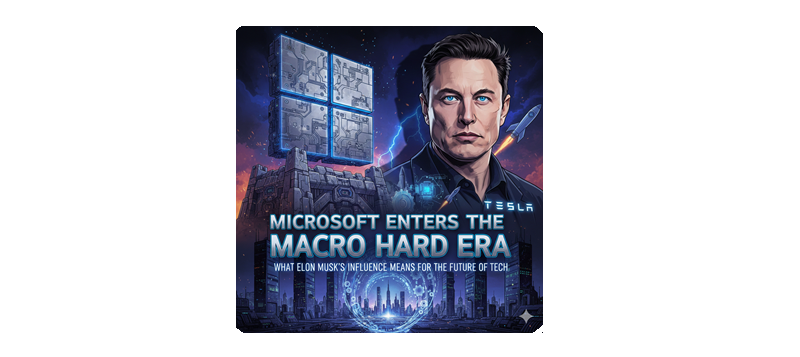
The technology landscape is evolving faster than ever, and a new phrase has begun circulating among analysts and industry observers: “Macro Hard.” While not an official Microsoft term, it reflects a broader transformation inside the company—one defined by massive infrastructure investments, enterprise-scale artificial intelligence, and high-stakes competition.
At the same time, Elon Musk continues to reshape the AI conversation through ventures like xAI and his ongoing commentary about the risks and governance of artificial intelligence. Whether directly collaborating or competing, Musk’s presence has intensified the urgency across Big Tech to move faster and think bigger.
So what exactly is the Macro Hard era? Why is Musk part of the discussion? And what does this mean for businesses, developers, and everyday users?
Let’s explore.
What Is the “Macro Hard” Concept?
“Macro Hard” combines two ideas:
- Macro-scale technology investments — multi-billion-dollar data centers, AI chips, and global cloud expansion.
- Hard infrastructure — the physical computing power required to train and run next-generation AI systems.
For Microsoft, this shift is visible in three major areas:
1. AI-First Product Strategy
Microsoft has embedded AI into nearly every flagship product:
- Microsoft 365 Copilot
- Azure AI services
- GitHub Copilot
- Security automation tools
Rather than treating AI as an add-on feature, the company is rebuilding its ecosystem around intelligent assistance.
2. Hyperscale Cloud Expansion
Modern AI models demand enormous computational resources. Microsoft has responded by expanding Azure regions and investing heavily in GPU clusters capable of handling advanced workloads.
3. Enterprise-Centric AI
Unlike some competitors that focus primarily on consumer tools, Microsoft is positioning itself as the default AI provider for enterprises—where long-term revenue is more predictable.
This macro-level infrastructure approach is what analysts increasingly associate with the “Macro Hard” mindset.
Why Elon Musk Is Part of the Conversation
Even without formal ties to Microsoft, Musk influences the broader AI narrative in several important ways.
A Catalyst for Competition
Musk’s AI company, xAI, represents a growing challenge to established players. Every time a new model launches or a bold claim is made about AI safety or capability, competitors feel pressure to respond.
Competition often accelerates innovation—and Microsoft knows it cannot afford complacency.
A Voice on AI Risk
Musk has repeatedly warned about uncontrolled AI development. While opinions differ, these warnings have pushed the industry toward:
- More transparency
- Stronger governance
- Ethical AI frameworks
Microsoft has responded by emphasizing responsible AI principles and internal oversight processes.
Talent and Capital Movement
When high-profile founders enter a space, talent follows. Engineers, researchers, and investors gravitate toward ambitious projects, creating a ripple effect across the industry.
This dynamic forces companies like Microsoft to remain attractive destinations for top-tier AI expertise.
The Strategic Implications for Microsoft
Entering the Macro Hard era is not just about spending money—it’s about redefining long-term positioning.
From Software Giant to Infrastructure Powerhouse
Historically, Microsoft dominated through operating systems and productivity software. Today, its future is increasingly tied to AI infrastructure.
Think of Azure as the digital equivalent of highways—critical pathways enabling the AI economy.
Companies that control infrastructure often capture the largest share of value.
Vertical Integration Is Increasing
Microsoft is steadily integrating the AI stack:
- Hardware partnerships
- Cloud compute
- Foundation models
- Developer tools
- End-user applications
This reduces dependency on external providers and improves performance optimization.
Recurring Revenue Through AI
Subscription-based AI services create predictable income streams. Enterprises adopting AI rarely switch providers quickly due to migration complexity, making customer retention stronger.
Microsoft vs. Musk: Competition or Parallel Innovation?
It would be simplistic to frame this as a direct rivalry. Instead, the relationship resembles parallel innovation paths.
| Microsoft | Elon Musk’s Ecosystem |
|---|---|
| Enterprise-focused | Research-driven |
| Platform strategy | Model-centric approach |
| Compliance-heavy | Speed-oriented |
| Corporate partnerships | Founder-led execution |
Both approaches push the industry forward—but in different directions.
For customers, this often results in better tools and faster progress.
The Infrastructure Arms Race
Training advanced AI models can cost hundreds of millions of dollars. As a result, we are witnessing an infrastructure arms race among tech giants.
Key battlegrounds include:
Specialized AI Chips
Companies are racing to secure GPU supply and design custom accelerators.
Energy Consumption
AI data centers require massive electricity capacity, prompting investments in renewable energy and grid partnerships.
Geographic Expansion
Low-latency AI services require globally distributed infrastructure.
This is precisely the type of macro-level commitment that defines the Macro Hard era.
What This Means for Businesses
For organizations evaluating their technology roadmap, these developments carry real implications.
AI Will Become a Default Capability
Soon, AI won’t be a differentiator—it will be expected.
Businesses that delay adoption risk falling behind competitors who automate workflows and extract insights faster.
Vendor Selection Matters More Than Ever
Choosing a cloud provider increasingly means choosing an AI ecosystem.
Decision-makers should evaluate:
- Model availability
- Security features
- Integration capabilities
- Compliance standards
Switching later can be expensive.
Productivity Gains Are Real
Early adopters report improvements in:
- Developer velocity
- Customer support automation
- Document processing
- Threat detection
The ROI case for AI is strengthening.
Developers Are Entering a Golden Age
For developers, the Macro Hard era may be one of the most opportunity-rich periods in decades.
Why?
Because AI is becoming a development multiplier rather than a replacement.
Engineers now spend less time on repetitive coding and more on architecture, problem-solving, and innovation.
High-demand skills include:
- AI orchestration
- Prompt engineering
- Cloud-native development
- Data pipeline design
- Security engineering
The message is clear: developers who adapt will thrive.
Risks Microsoft Must Navigate
Despite its strong position, the journey is not risk-free.
Cost Pressure
AI infrastructure requires staggering capital expenditure. Profitability depends on sustained enterprise adoption.
Regulatory Scrutiny
Governments worldwide are exploring AI regulations, which could affect deployment speed and operational flexibility.
Market Expectations
When a company leads in innovation, expectations rise quickly. Falling short—even temporarily—can impact investor confidence.
Talent Competition
Keeping elite researchers is increasingly challenging in a market full of ambitious AI startups.
The Bigger Picture: A Shift Toward AI Economies
The Macro Hard era signals something larger than a corporate strategy—it hints at the emergence of AI-driven economies.
Future economic strength may correlate with access to:
- Compute power
- Data ecosystems
- AI talent
- Energy resources
In this environment, technology companies begin to resemble digital nation-states, operating vast infrastructure that supports entire business ecosystems.
Is This the Start of a New Tech Supercycle?
Many analysts believe we are entering a new supercycle comparable to:
- The PC revolution
- The internet boom
- The mobile era
- The cloud transformation
AI could surpass them all in economic impact.
If that prediction holds true, Microsoft’s Macro Hard positioning may prove strategically brilliant—placing the company at the center of the next technological epoch.
What Should Leaders Watch Next?
Several signals will reveal how this era unfolds:
✔ Expansion of AI-native applications
✔ Enterprise AI standardization
✔ Faster model deployment cycles
✔ Industry-specific AI platforms
✔ Increased public-private partnerships
And perhaps most importantly:
✔ Continued influence from visionary founders like Elon Musk, whose ambitions keep the competitive temperature high.
Conclusion
The phrase “Macro Hard” captures a defining reality of modern technology: scale is now the ultimate advantage.
Microsoft is betting that massive infrastructure, deeply integrated AI, and enterprise trust will secure its leadership position.
Meanwhile, Elon Musk’s relentless push for faster and more powerful AI ensures the industry never stands still.
Whether viewed as competition, inspiration, or parallel progress, one thing is certain:
👉 The future of technology will be built on macro-scale foundations—and companies prepared to go “hard” on infrastructure will shape that future.
For businesses, developers, and tech leaders, the takeaway is simple:
The AI era is no longer approaching. It has already begun.
Related posts:
 Storeware: Enterprise Backup and Recovery Solution
Kaspersky Rescue Disk Version 06.02.2023
Apache Kafka or Apache Spark : Which One Will You Choose ?
Storeware: Enterprise Backup and Recovery Solution
Kaspersky Rescue Disk Version 06.02.2023
Apache Kafka or Apache Spark : Which One Will You Choose ?
 Exploring macOS Sonoma: Apple’s Revolutionary Operating System
 iOS 17: Key Features, Privacy Enhancements, and User Interface Updates for iPhone and iPad
Solid-state drives (SSDs): An Advantages of Using SSD
iOS 17: Key Features, Privacy Enhancements, and User Interface Updates for iPhone and iPad
Solid-state drives (SSDs): An Advantages of Using SSD
 LTO Tape Cartridge: A Reliable Storage Solution for Long-Term Data Preservation
Apple iPhone 17 Pro Max: Everything You Need to Know
LTO Tape Cartridge: A Reliable Storage Solution for Long-Term Data Preservation
Apple iPhone 17 Pro Max: Everything You Need to Know
