Apache Analytics Tools Compared: Superset vs Atlas vs Arrow vs Iceberg vs Doris (2026 Guide)

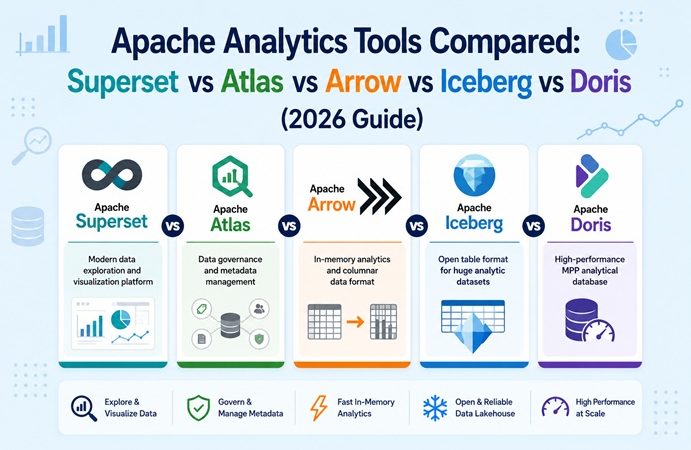
If you searched for “apache analytics” and landed here, you’ve probably noticed the problem already: the Apache Software Foundation hosts more than a dozen projects with “analytics” somewhere in their pitch — Superset, Atlas, Arrow, Iceberg, Doris, Impala, Hive, Parquet, HBase, Spark, Flink, Kafka. They get lumped together constantly, but they solve completely different problems and sit at completely different layers of a data stack.
Table of Contents
- Why “Apache Analytics” Confuses Search Results
- The Big Picture: These Tools Aren’t Competitors
- Architecture: How They Fit Together
- Comparison Table
- Deep Dive: Apache Superset (Visualization Layer)
- Deep Dive: Apache Atlas (Governance Layer)
- Deep Dive: Apache Arrow (In-Memory Format)
- Deep Dive: Apache Iceberg (Table Format)
- Deep Dive: Apache Doris (Real-Time OLAP Engine)
- Decision Guide: Which Tool Do You Actually Need?
- Reference Architecture: Combining All Five
- Troubleshooting & Common Pitfalls
- FAQ
Why “Apache Analytics” Confuses Search Results
This guide exists to cut through that confusion. Instead of another generic “top Apache projects” listicle, we’re going to compare the five tools people most often confuse for competitors — Superset, Atlas, Arrow, Iceberg, and Doris — explain exactly where each one sits in a real analytics pipeline, and help you figure out which one (or which combination) your project actually needs.
The Big Picture: These Tools Aren’t Competitors
Here’s the core misunderstanding worth clearing up immediately: none of these five tools compete with each other. They occupy five distinct layers of the modern analytics stack:
| Layer | Tool | What it actually is |
|---|---|---|
| Presentation / BI | Apache Superset | Dashboard and data-exploration UI |
| Governance / Metadata | Apache Atlas | Catalog, lineage, and classification system |
| In-memory format | Apache Arrow | Columnar memory layout for fast data exchange |
| Table format | Apache Iceberg | Transactional layer on top of files in a data lake |
| Query engine / database | Apache Doris | Real-time MPP analytical database |
You could — and in mature data platforms, often do — run all five in the same stack simultaneously without any of them stepping on each other’s toes. That’s the single most important thing to understand before choosing between them: the question isn’t “Superset or Doris?” It’s “which layer am I trying to solve for?”
Architecture: How They Fit Together
Here’s a simplified view of where each tool sits in a typical pipeline, from raw data to a dashboard on someone’s screen:
┌──────────────────────────────────────────────────────────────┐
│                         DATA SOURCES                         │
│         (application DBs, logs, Kafka topics, APIs)          │
└───────────────────────────┬──────────────────────────────────┘
                            │
                            ▼
                 ┌───────────────────────┐
                 │   INGESTION LAYER     │
                 │  (Kafka, Flink, ETL)  │
                 └───────────┬───────────┘
                             │  data written as columnar files
                             ▼
                 ┌───────────────────────┐
                 │   STORAGE + TABLE     │
                 │       FORMAT          │
                 │   Apache Iceberg      │◄──── metadata/lineage
                 │  (ACID tables on S3/  │      tracked by
                 │ HDFS/object storage)  │      Apache Atlas
                 └───────────┬───────────┘
                             │  queried via
                             ▼
                 ┌───────────────────────┐
                 │   QUERY / OLAP ENGINE │
                 │     Apache Doris      │
                 │  (sub-second SQL over │
                 │   Iceberg + native    │
                 │   storage)            │
                 └───────────┬───────────┘
                             │  result sets exchanged as
                             │  Apache Arrow columnar buffers
                             ▼
                 ┌───────────────────────┐
                 │  VISUALIZATION LAYER  │
                 │    Apache Superset    │
                 │ (dashboards, SQL Lab, │
                 │ charts for end users) │
                 └───────────────────────┘
Notice Apache Arrow doesn’t have its own box in the pipeline — that’s intentional. Arrow isn’t a stage of the pipeline; it’s the in-memory data format that most of the other tools (Doris, Spark, Trino, Superset’s backend drivers) use internally to move data between each other without expensive serialization. It’s plumbing, not a destination.
Apache Atlas also isn’t a hop in the data flow — it’s a side-car system that watches everything else and answers “where did this column come from, and who’s allowed to see it?”
Comparison Table
| Tool | Category | Primary Language | Typical Deployment | Best For | Not Designed For |
|---|---|---|---|---|---|
| Superset | BI / Visualization | Python (Flask) | Docker Compose, Kubernetes | Dashboards, ad-hoc SQL exploration, self-service BI | Storing or processing data itself |
| Atlas | Metadata & Governance | Java | Hadoop-adjacent clusters, standalone | Data lineage, classification, compliance (GDPR/PDP) | Query execution or visualization |
| Arrow | In-memory columnar format | C++, with bindings (Python, Java, Rust, Go) | Embedded library, not a standalone service | Fast data interchange between engines, zero-copy reads | Persistent storage or querying on its own |
| Iceberg | Open table format | Java, with Python/Rust bindings | Layered on S3, HDFS, GCS, ADLS | ACID transactions, schema/partition evolution on data lakes | Serving low-latency point queries directly |
| Doris | Real-time OLAP database | C++, Java (FE) | MPP cluster (FE + BE nodes) | Sub-second SQL analytics, real-time dashboards, log analytics | Long-term governed metadata catalog |
Deep Dive: Apache Superset
Apache Superset is the layer end users actually see — dashboards, charts, and an in-browser SQL editor (SQL Lab). It connects to dozens of backends (PostgreSQL, MySQL, Doris, Trino, BigQuery, ClickHouse) and turns query results into interactive visualizations without writing frontend code.
For IT operations teams specifically, Superset is commonly used to visualize infrastructure metrics, build incident-review dashboards, and give non-technical stakeholders a self-service way to explore system data without SQL knowledge.
📖 Full breakdown: Apache Superset: A Powerful Open-Source Data Visualization Tool for IT Operation Engineers
Deep Dive: Apache Atlas
Apache Atlas is a metadata management and governance framework, originally built for Hadoop ecosystems but now used far more broadly. It answers questions that visualization and query tools can’t: What data exists? Where did it come from? Who’s allowed to see it? Atlas tracks data lineage end-to-end and lets teams classify sensitive fields (PII, confidential) for compliance with regulations like GDPR or Indonesia’s PDP Law.
Atlas doesn’t store or query your actual data — it stores metadata about your data, in a graph database (typically JanusGraph backed by HBase), searchable through Solr or Elasticsearch.
📖 Full breakdown: Understanding Apache Atlas: The Open-Source Framework for Metadata Management and Data Governance
📖 Installation guide: How to Install Apache Atlas on Ubuntu 24.04 LTS
Deep Dive: Apache Arrow
Apache Arrow defines a standardized, language-independent columnar memory format. Instead of every engine serializing and deserializing data into its own internal representation every time it talks to another system, tools that support Arrow can pass data between each other with zero-copy reads — no conversion overhead.
This matters enormously in a stack that includes Doris, Spark, Trino, and Python-based tooling (pandas, DuckDB): Arrow is what lets those systems exchange large result sets quickly instead of paying a serialization tax at every hop.
📖 Full breakdown: Understanding Apache Arrow: The Future of High-Performance Data Processing
📖 Installation guide: How to Install Apache Arrow on Docker
Deep Dive: Apache Iceberg
Apache Iceberg is an open table format for huge analytic datasets, originally built at Netflix to solve the operational headaches of Hive tables. It adds ACID transactions, schema evolution without rewrites, and hidden partitioning on top of files sitting in a data lake (S3, HDFS, GCS). Multiple engines — Spark, Trino, Flink, Doris — can safely read and write the same Iceberg tables concurrently.
In practice, Iceberg is the layer that turns “a folder full of Parquet files” into something that behaves like a governed, transactional SQL table.
📖 Full breakdown: Apache Iceberg: The Next-Generation Table Format for Big Data Analytics
📖 Installation guide: How to Install Apache Iceberg on Docker
📖 Hands-on experiment: Exploring Trino with Apache Iceberg
Deep Dive: Apache Doris
Apache Doris is a real-time MPP (Massively Parallel Processing) analytical database. Unlike Hive or Spark, which were built around batch processing, Doris is designed for sub-second SQL response times — even under high concurrency — making it well suited for operational dashboards, real-time log analysis, and interactive BI where users expect Superset dashboards to feel instant.
Doris speaks the MySQL wire protocol, so most existing SQL tooling connects to it without modification, and it can query Iceberg tables directly for lakehouse-style architectures instead of requiring data to be duplicated into its own storage.
📖 Full breakdown: Apache Doris: Real-Time Analytics Made Simple for Modern Enterprise
Decision Guide: Which Tool Do You Actually Need?
| Your situation | Reach for |
|---|---|
| “I need a dashboard my team can look at” | Superset |
| “I need to know which team owns this column and whether it contains PII” | Atlas |
| “My Python and Spark jobs are slow because of serialization overhead” | Arrow (usually already bundled in your engine — check it’s enabled) |
| “My data lake files need schema changes without a full rewrite” | Iceberg |
| “My dashboards feel sluggish and queries take 10+ seconds” | Doris (or another real-time OLAP engine) |
| “I need all of the above in one governed, fast, visualized stack” | All five, layered as shown in the architecture diagram above |
If you’re only trying to solve one specific pain point, pick the single tool from the table. If you’re designing a new analytics platform from scratch, the five layers above represent a defensible, production-proven reference stack — this exact combination (Iceberg for storage, Doris for query, Arrow for interchange, Atlas for governance, Superset for visualization) is used by real-world data platforms for a reason: each tool does one job well instead of one tool trying to do everything poorly.
Reference Architecture: Combining All Five
Here’s a simplified docker-compose.yml skeleton showing how Superset and Doris (the two services you’d actually deploy as containers) fit together, with Doris configured as a Superset data source:
version: '3.8'

services:
  doris-fe:
    image: apache/doris:fe-latest
    container_name: doris-fe
    ports:
      - "8030:8030"   # Web UI
      - "9030:9030"   # MySQL protocol port
    volumes:
      - doris_fe_data:/opt/apache-doris/fe/doris-meta

  doris-be:
    image: apache/doris:be-latest
    container_name: doris-be
    depends_on:
      - doris-fe
    volumes:
      - doris_be_data:/opt/apache-doris/be/storage

  superset:
    image: apache/superset:latest
    container_name: superset
    depends_on:
      - doris-fe
    ports:
      - "8088:8088"
    environment:
      - SUPERSET_SECRET_KEY=change_this_in_production
    volumes:
      - superset_home:/app/superset_home

volumes:
  doris_fe_data:
  doris_be_data:
  superset_home:
Once both services are up, add Doris as a database connection inside Superset using its MySQL-compatible driver:
doris://root:@doris-fe:9030/your_databaseFrom there, any table Doris exposes — including Iceberg tables it queries externally — becomes available to build dashboards on in Superset, with Arrow handling the in-memory transfer under the hood and Atlas (deployed separately) tracking lineage for every column that flows through the pipeline.
Troubleshooting & Common Pitfalls
| Symptom | Likely Cause | Fix |
|---|---|---|
| Superset dashboard queries time out | Doris BE nodes under-provisioned, or query hitting Iceberg without partition pruning | Check Doris BE resource limits; verify Iceberg table partitioning matches query filters |
| Doris can’t connect to Iceberg catalog | Missing or misconfigured catalog properties (S3 credentials, metastore URI) | Verify CREATE CATALOG statement includes correct type=iceberg and storage credentials |
| Atlas hooks not capturing lineage from Spark/Hive jobs | Hook JARs not on classpath, or Atlas Kafka topic not reachable | Confirm hook installation per Atlas docs and that the Kafka broker Atlas listens on is reachable from the job cluster |
| Arrow-based reads slower than expected | Falling back to row-by-row conversion instead of zero-copy | Confirm both source and destination libraries actually support the Arrow C Data Interface, not just “Arrow-compatible” APIs |
| Superset shows stale data after Iceberg writes | Query result caching enabled with a long TTL | Lower the cache TTL for that dataset or trigger a manual cache invalidation after ETL runs |
Frequently Asked Questions
Is Apache Doris a replacement for Apache Superset?
No. Doris is a query engine/database; Superset is a visualization layer that sits on top of query engines like Doris. You typically use both together, not one instead of the other.
Do I need Apache Arrow if I’m not writing custom code?
Usually not directly — most modern engines (Doris, Spark, DuckDB, pandas) already use Arrow internally. You only need to think about it explicitly if you’re building custom data-interchange code between systems.
Can Apache Atlas work without Hadoop?
Yes, though it was originally built for Hadoop ecosystems, Atlas can be deployed standalone and integrated with modern data platforms via custom hooks, independent of HDFS or Hive.
Does Iceberg require a specific query engine?
No — that’s the point of an open table format. Spark, Trino, Flink, and Doris can all read and write the same Iceberg tables.
Which of these five tools should a small team start with first?
If you’re starting from zero: Superset first (immediate visible value), then whichever query engine fits your data volume (Doris if you need real-time speed), and add Iceberg/Atlas once your data lake and governance needs grow past what a single database can handle.
Related bckinfo.com Guides
- How to Install Apache Superset with Docker Compose
- How to Install Apache Atlas on Ubuntu 24.04 LTS
- How to Install Apache Iceberg on Docker
- Exploring Trino with Apache Iceberg
- Introduction to Apache Parquet
- What is Apache Impala?
Related posts:
 How to Install Apache Atlas on Ubuntu 24.04 LTS — A Complete Guide
 Understanding Apache Arrow: The Future of High-Performance Data Processing
How to Install Apache Arrow on Docker: A Complete Step-by-Step Guide
Understanding Apache Arrow: The Future of High-Performance Data Processing
How to Install Apache Arrow on Docker: A Complete Step-by-Step Guide
 How to Install Apache Kafka on Docker (Step-by-Step Guide)
 How To Install Apache Airflow 2.1 On Ubuntu 20.04 LTS Step by Step Guide
 How To Install Apache Web Server On Fedora 38
 Apache Subversion (SVN): A Comprehensive Guide
 Apache Iceberg: The Next-Generation Table Format for Big Data Analytics
