Oracle Linux 10 vs Rocky Linux 10 vs AlmaLinux 10: Which RHEL Clone Fits Your Workload?

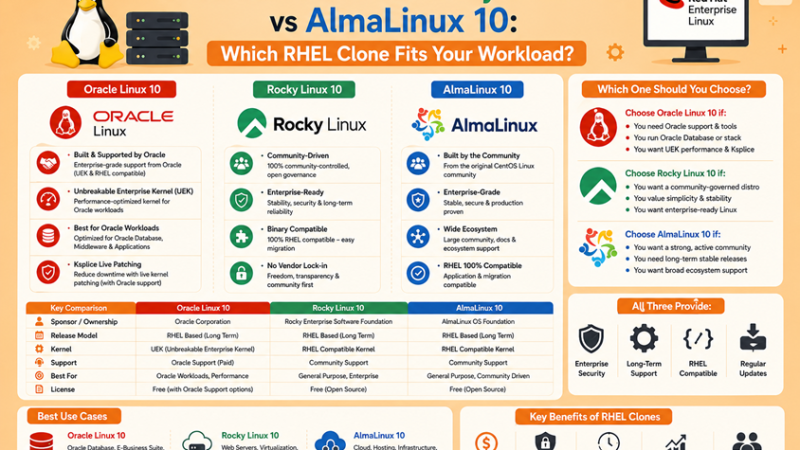
Since CentOS Linux ended, the “free enterprise Linux” question has three common answers: Rocky Linux, AlmaLinux, and Oracle Linux. All three are compatible with Red Hat Enterprise Linux (RHEL), all three offer ten-year lifecycles, and all three run the same familiar dnf, systemd, and SELinux stack. The differences that matter are governance, how strictly each tracks RHEL, kernel options, hardware requirements, and who stands behind you when something breaks.
This guide compares the three major 10 releases as of late 2026 and ends with a scenario-based decision guide.
Table of Contents
- Quick verdict
- Family tree: where each distribution comes from
- Release snapshot
- Comparison table
- Compatibility philosophy
- CPU and hardware requirements
- Kernel options: RHCK vs UEK
- Lifecycle and support
- Day-to-day administration: what is identical
- Decision guide
- Checking what you run
- FAQ
1. Quick verdict
| Your situation | Pick |
|---|---|
| General servers, homelab, web and database hosting, you want a “plain RHEL” experience | Rocky Linux 10 |
| You need older x86-64-v2 hardware to keep working, or you prefer faster upstream tracking | AlmaLinux 10 |
| You run Oracle software, want UEK and Ksplice, or want one vendor for OS and database support | Oracle Linux 10 |
| Regulated environment that demands a certified vendor and ISV support matrix | RHEL 10 itself |
For most readers who just need a stable, free server operating system, Rocky Linux and AlmaLinux are interchangeable. Choose by the specific factors below.
2. Family tree
   Fedora
      |
      v
   CentOS Stream 10  (upstream development branch of RHEL)
      |
      v
   RHEL 10  (Red Hat Enterprise Linux, subscription)
      |
      +-----------------+-------------------+----------------------+
      |                 |                   |                      |
      v                 v                   v                      v
 Rocky Linux 10   AlmaLinux 10      Oracle Linux 10        (CentOS Stream 10
 (rebuild of      (ABI-compatible   (binary-compatible      stays upstream,
  RHEL sources)    build; extra      rebuild + optional     not downstream)
                   x86-64-v2 build)  UEK kernel)
3. Release snapshot
| RHEL 10 | Rocky Linux 10 | AlmaLinux 10 | Oracle Linux 10 | |
|---|---|---|---|---|
| Major release (GA) | 20 May 2025 | 11 June 2025 (“Red Quartz”) | 27 May 2025 (“Purple Lion”) | 26 June 2025 |
| Latest minor (at writing) | 10.2 (May 2026) | 10.2 (late May 2026) | 10.2 (26 May 2026) | 10.1 (December 2025) per the sources checked |
| Lag behind RHEL (10.0) | n/a | about 3 weeks | about 1 week | about 6 weeks |
| Governance | Red Hat (IBM) | Rocky Enterprise Software Foundation, community | AlmaLinux OS Foundation, non-profit | Oracle Corporation |
| Commercial support | Red Hat | CIQ and other vendors | TuxCare and other vendors | Oracle |
4. Comparison table
| Feature | Rocky Linux 10 | AlmaLinux 10 | Oracle Linux 10 |
|---|---|---|---|
| Cost to download and use | Free | Free | Free (support is a paid subscription) |
| RHEL compatibility target | Bug-for-bug rebuild | ABI compatible | Binary compatible |
| Default kernel | RHEL kernel (6.12 series) | RHEL kernel (6.12 series) | UEK 8.x by default on new installs, RHEL-compatible kernel selectable |
| Extra kernel option | No | No | Yes (UEK, based on Linux 6.12 LTS) |
| x86-64-v2 hardware | No (needs v3) | Yes, separate build | No (needs v3, as checked in the sources) |
| Live kernel patching | Via third parties | Via third parties (for example TuxCare) | Ksplice, part of Oracle Premier Support |
| Architectures | x86-64-v3, ARM64, ppc64le, s390x, riscv64 | x86-64-v3 and v2, ARM64, ppc64le, s390x | x86-64, ARM64 |
| Lifecycle | 10 years | 10 years | 10 years Premier, plus Extended Support |
| Best known for | RHEL-faithful, large community | Fast releases, wide hardware reach | Oracle product integration, UEK |
| Package repositories | BaseOS, AppStream, CRB, extras, plus EPEL | BaseOS, AppStream, CRB, extras, plus EPEL | Oracle-hosted yum repositories (and EPEL-equivalents) |
5. Compatibility philosophy
Rocky Linux aims to be a one-to-one rebuild of the RHEL source packages. If software works on RHEL 10, it should behave the same on Rocky. That makes it the lowest-surprise choice for people migrating from CentOS or following RHEL documentation.
AlmaLinux moved from a strict rebuild to ABI compatibility: applications built for RHEL run unchanged, but some packages may carry small differences (extra hardware support, faster fixes). In practice the gap is small and rarely affects applications. Its advantage is speed: AlmaLinux 10 appeared about a week after RHEL 10.
Oracle Linux is binary compatible with RHEL and adds its own kernel option and tooling. It has historically been the only major clone backed by a large vendor, which matters in procurement and support discussions.
6. CPU and hardware requirements
RHEL 10 raised the minimum CPU baseline to x86-64-v3 (Intel Haswell and AMD equivalents, roughly 2013 and later, with AVX2). Rocky Linux 10 inherits that requirement. AlmaLinux 10 also publishes a build for x86-64-v2 processors (roughly 2008 and later), so older servers and lab hardware keep working.
Check your CPU before you download an ISO:
# Look for avx2, bmi2 and fma flags (needed for x86-64-v3)
grep -m1 -o -E 'avx2|bmi2|fma' /proc/cpuinfo | sort -u

# Or ask the dynamic loader which microarchitecture levels are supported
/lib64/ld-linux-x86-64.so.2 --help | grep -E 'x86-64-v[234]'
If x86-64-v3 is not listed as “supported”, the v3-only distributions will not boot on that machine, and AlmaLinux’s v2 build (or an older release) is your option.
7. Kernel options: RHCK vs UEK
Rocky Linux and AlmaLinux ship the same RHEL-derived kernel line as Red Hat (version 6.12 with backports). Oracle Linux 10 offers two kernels:
| Kernel | What it is | When to choose it |
|---|---|---|
| RHCK (Red Hat Compatible Kernel) | The RHEL-compatible kernel | Maximum compatibility with RHEL-certified third-party modules |
| UEK (Unbreakable Enterprise Kernel) | Oracle’s kernel, built on a Linux 6.12 LTS base and updated more frequently, with extra drivers and features | Oracle workloads, newer hardware features, Oracle-supported stacks |
For new Oracle Linux 10 installations, UEK is installed and set as the default kernel. UEK 8.2 later added features such as Intel TDX guest and hypervisor support for confidential computing and XFS online repair through xfs_scrub.
Switching the default kernel on Oracle Linux:
# List installed kernels
sudo grubby --info=ALL | grep -E '^(index|kernel|title)'

# Show and change the default
sudo grubby --default-kernel
sudo grubby --set-default=/boot/vmlinuz-<version>
Test third-party kernel modules (storage, GPU, security agents) against the kernel you choose before production use.
8. Lifecycle and support
| Rocky Linux 10 | AlmaLinux 10 | Oracle Linux 10 | |
|---|---|---|---|
| Active support | until 31 May 2030 | until 31 May 2030 | Premier support until 30 June 2035 |
| Security / extended | security fixes to 31 May 2035 | security support to 31 May 2035 | Extended support to 30 June 2038 |
| Minor release cadence | Roughly every six months (May and November) | Follows RHEL, usually within days | Follows RHEL, usually within weeks |
Notes:
- Community distributions follow Red Hat’s lifecycle: five years of active support and five years of security support.
- Oracle’s Premier Support includes live kernel patching (Ksplice) and ties into Oracle’s support contracts for its database and middleware.
- Paid support for Rocky and AlmaLinux comes from third-party vendors, and SLAs differ by provider. Ask for the SLA, not only the logo.
9. Day-to-day administration
For ordinary administration the three are nearly identical, so skills transfer directly:
| Task | Command (same on all three) |
|---|---|
| Package management | dnf install, dnf upgrade, dnf repoquery |
| Services | systemctl, journalctl |
| Firewall | firewall-cmd (see firewalld on Rocky Linux 10) |
| SELinux | getenforce, semanage, restorecon (see SELinux troubleshooting) |
| Hostname | hostnamectl set-hostname (see change hostname on Oracle Linux) |
| Databases | PostgreSQL 18 is packaged for EL 10.2 and compatible rebuilds; see PostgreSQL 18 on Rocky Linux 10.2. On Oracle Linux run dnf info postgresql18-server to confirm availability |
Where they differ: repository names and URLs, release package names (rocky-release, almalinux-release, oraclelinux-release), branding in /etc/os-release, and Oracle’s own repositories for UEK and Oracle software. If you coming from Ubuntu, the Rocky Linux vs Ubuntu command cheat sheet maps the differences.
10. Decision guide
| Scenario | Recommendation | Reason |
|---|---|---|
| Homelab or small business servers | Rocky or AlmaLinux | Free, well documented, same behavior as RHEL |
| Older server hardware (pre-2013 CPUs) | AlmaLinux 10 (v2 build) or an older major release | Only AlmaLinux 10 supports x86-64-v2 |
| Running Oracle Database, middleware, or Oracle-certified stacks | Oracle Linux (or RHEL) | Oracle develops and tests its products on Oracle Linux; check the certification matrix for your exact product and version |
| Need live kernel patching without reboots | Oracle Linux (Ksplice with Premier Support) or a third-party live patch for Rocky/Alma | Reduces maintenance windows |
| Strict ISV or regulatory certification | RHEL 10 | Widest vendor certification; community clones are generally not listed as certified |
| You follow RHEL docs and want zero surprises | Rocky Linux | Bug-for-bug rebuild goal |
| You want the newest minor release fastest | AlmaLinux | Typically ships within days of RHEL |
| Mixed fleet with Kubernetes nodes | Rocky or AlmaLinux | Large community recipes for kubeadm and container runtimes |
| Cloud images | Whatever your provider supports | Oracle Linux is first-class on OCI; Rocky and Alma have images on major clouds |
A practical rule: choose the distribution your application vendor supports in writing, then pick among the rest by hardware, kernel needs, and support contract. For an enterprise Oracle project, that written support statement usually decides the question.
11. Checking what you run
cat /etc/os-release
cat /etc/redhat-release
uname -r
rpm -q --whatprovides system-release
dnf repolist
Record the OS name, version, and kernel in your runbooks and CMDB. Ticket handlers later need to know whether a host runs RHCK or UEK.
12. FAQ
Is Rocky Linux or AlmaLinux better?
Neither is universally better. Rocky targets bug-for-bug RHEL fidelity, while AlmaLinux targets ABI compatibility with faster releases and wider hardware support. Both are free, community-governed, and supported for ten years.
Is Oracle Linux free?
Yes. You can download, use, and redistribute it at no cost. You pay only if you want Oracle’s support subscription, which also includes features such as Ksplice live patching.
Does AlmaLinux 10 really run on older CPUs?
It provides a separate x86-64-v2 build for older processors, which RHEL 10 and Rocky Linux 10 do not.
Can I run Oracle Database on Rocky Linux or AlmaLinux?
They are binary compatible with RHEL and are commonly used for development and test, but Oracle certifies its products against specific distributions. Check Oracle’s certification matrix and your support contract before using them in production.
Can I migrate between these distributions?
Conversion scripts exist for earlier major versions (for example, tools published by each project), but support for version 10 conversions varies. Verify the current status in each project’s documentation, and prefer a fresh install and data migration for production systems.
Which one should I install for a Kubernetes or Docker host?
Rocky Linux or AlmaLinux. Both have extensive community guides, and the container tooling behaves identically.
Related posts:
 Rocky Linux vs Ubuntu: Command Cheat Sheet for Sysadmins
 NGINX Ingress on Rocky Linux 10 Kubernetes (kubeadm)
 Longhorn Persistent Storage on Rocky Linux 10 Kubernetes
 How to Install Buildah and Podman on Rocky Linux 10 (Rootless Containers & SELinux)
 How to Create and Configure a Virtual Machine in VMware ESXi On Rocky Linux 10 (Step-by-Step)
 Changing Hostname on Rocky Linux 8
 How To Add User to Sudoers on CentOS 7
 20 systemctl Command Line Examples for System and Service Management
